Dynamics 365
 Power Platform
 Dynamics
 Cloud & Productivity
Microsoft Dynamics 365 Finance & Supply Chain Management for distributors with complex pricing, rebates, and inventory

Distribution rarely stays simple for long. A distributor may quote one price to a national account, another to a regional buyer, and a third through a B2B storefront. Vendor rebate programs run in the background. Inventory sits across several warehouses, and customers still expect an accurate ship date on the first call. Most enterprise resource planning (ERP) systems handle one of those problems well. Fewer handle all three at once.
Microsoft Dynamics 365 Finance and Supply Chain Management brings pricing, rebates, inventory, warehousing, transportation, and financial reporting together in one connected ERP platform. Commonly referred to as Dynamics 365 Finance and Operations, Dynamics 365 F&O, or Dynamics 365 F&SCM, the platform is designed for organizations whose operational and financial requirements have outgrown simpler ERP systems.
This blog looks at the capabilities that matter most to distributors and where the platform fits best.
At a glance
Microsoft Dynamics 365 Finance and Supply Chain Management is a cloud ERP platform for distributors that need advanced pricing, rebate, inventory, warehouse, transportation, and financial capabilities. It is best suited to organizations managing multiple locations, complex customer or contract pricing, active vendor rebate programs, imported inventory, or multi-entity operations. The platform connects these processes in one system, helping sales teams make more reliable order commitments while giving operations and finance greater visibility into inventory, costs, and margins.
Table of contents
- What is Dynamics 365 Finance and Supply Chain Management?
- How Dynamics 365 F&SCM supports complex distribution
- Distribution models supported by Dynamics 365 F&SCM
- When should a distributor consider Dynamics 365 F&SCM?
- Best practices for implementing Dynamics 365 F&SCM in distribution
- Work with an experienced Dynamics 365 F&SCM distribution partner
- Key takeaways
- Frequently asked questions
What is Dynamics 365 Finance and Supply Chain Management?
Dynamics 365 Finance and Dynamics 365 Supply Chain Management are cloud ERP applications for organizations with demanding financial and operational requirements.
Dynamics 365 Finance covers the general ledger, accounts payable, accounts receivable, budgeting, cash management, cost accounting, fixed assets, and financial reporting. Dynamics 365 Supply Chain Management covers product information, procurement, inventory, warehousing, transportation, pricing, rebates, planning, and cost management.
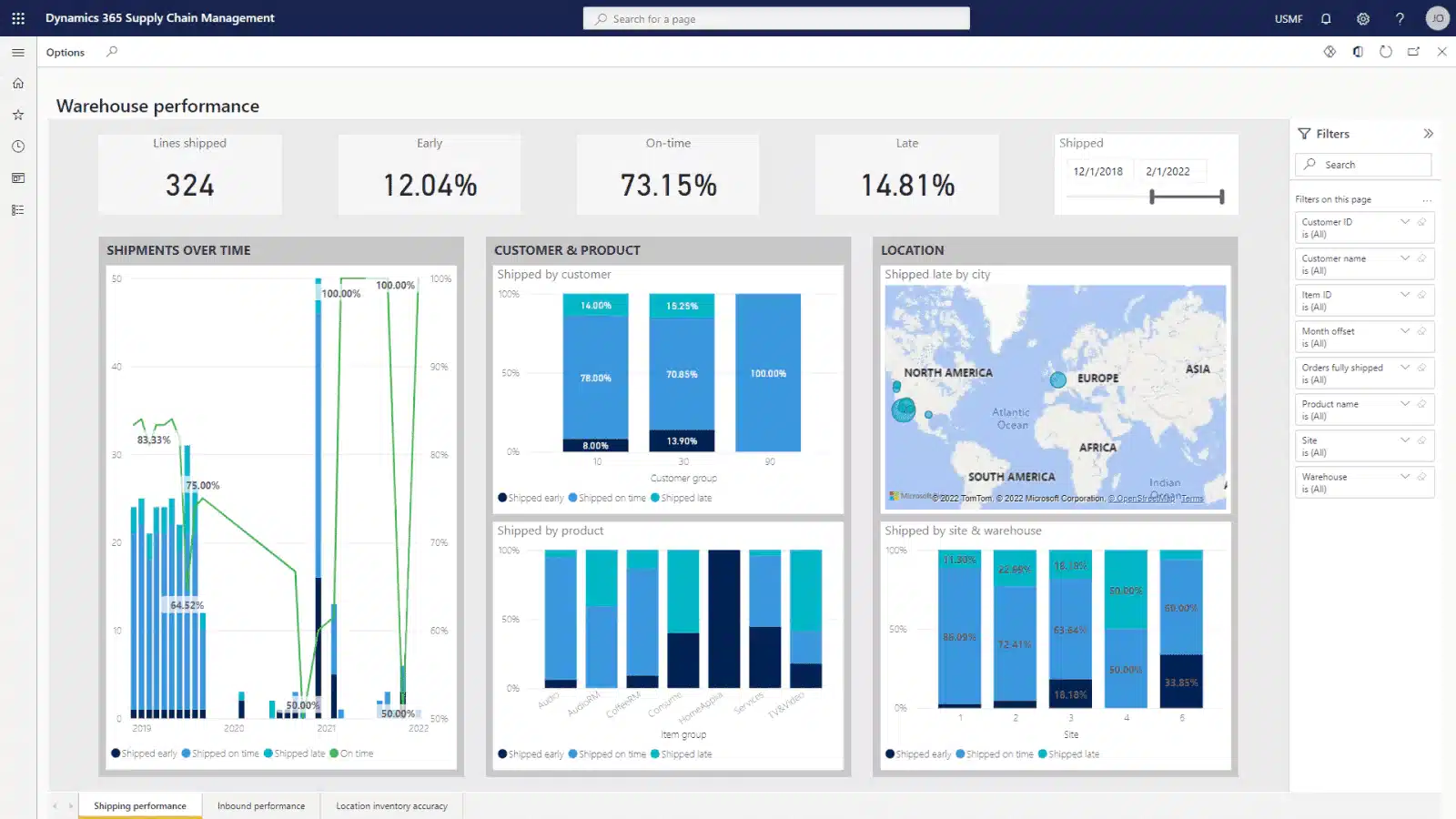
For distributors, the value sits in the connection between them. A price adjustment, a rebate accrual, a short shipment, and a freight cost all land in the same ledger. Sales teams see what they can commit to. Finance sees what each order actually earned. That link matters most for companies running several warehouses, business units, or legal entities. Buyers can react to a supply gap while finance sees the effect on inventory value and gross margin.
How Dynamics 365 F&SCM supports complex distribution
Dynamics 365 F&SCM includes a wide set of capabilities that can be configured around a distributor’s customers, products, suppliers, and facilities.
Attribute-based pricing with Unified pricing management
Pricing is where many distributors feel the limits of an older ERP first. The Unified pricing management module was built for this problem. It creates pricing rules from attributes and data drawn from customers, products, and order segments. Instead of maintaining thousands of separate price list records, teams define the logic once and let the system apply it.
The module works through four building blocks:
- Price attributes define the pricing factors, using information from customers, products, sales order headers, and sales order lines.
- Price component codes group price attributes together and act as the building blocks of a price structure.
- Price structures set the sequence of those component codes and determine the base price before adjustments.
- Concurrency modes decide the outcome when several rules apply to the same component code.
A single order can then account for base prices, sales trade agreements, long-term discount agreements, short-term promotions, and retrospective rebate calculations. Users can simulate a price and view the full component breakdown before quoting. Discount budget controls help protect margin when promotional funds get consumed faster than planned.

Rebates, royalties, and deductions
Rebate programs are often the least visible part of a distributor’s margin, and the hardest to audit. The Rebate management module handles contracts, deals, and agreements with both customers and vendors. It calculates rebates, deductions, and royalties, then tracks the resulting transactions in one place.
Distributors can configure:
- Calculation basis. Customer rebates can accrue from sales orders, delivery notes, or invoices. Vendor rebates can accrue from purchase orders or sales orders.
- Calculation method. Four methods are available: stepped, cumulative, rolling, and total value.
- Calculation period. Periods run by invoice, day, week, month, quarter, year, or a custom range.
- Scope. Rules can apply to individual customers and products, groups of them, or all of them.
- Outputs. Financial outputs include customer deduction journals, free text invoices, and vendor invoices. Item outputs create a free item sales order or a purchase order.
Provisions and write-offs post directly to the ledger, which keeps accruals visible instead of trapped in a spreadsheet. Every financial rebate transaction carries a reference back to the agreement that created it, which helps during an audit. The deduction workbench gives finance a single place to review and resolve customer deductions.
Approval workflows can sit on top of agreements, so a new rebate deal follows the same controls as any other commitment.

Real-time inventory visibility and availability
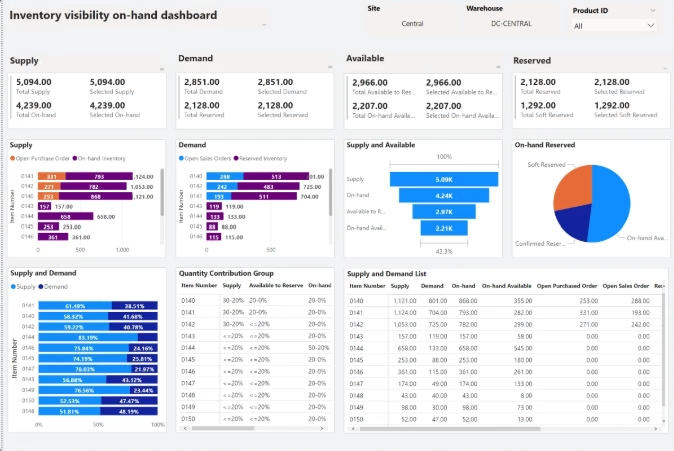
The Inventory Visibility add-in tracks on-hand inventory across data sources, warehouses, and locations in real time.
It supports several capabilities distributors rely on:
- Central status tracking across on-hand, ordered, purchased, in-transit, returned, and quarantined quantities.
- Soft reservations that flag quantities against demand without touching physical inventory, which helps prevent overselling across channels.
- Inventory allocation that reserves stock for a specific channel, customer group, or location.
- Available-to-promise calculations that return current and next-available dates.
The service runs on Microsoft Dataverse and exposes REST APIs. That makes it practical to connect a third-party warehouse management system, an order management system, or a storefront and still work from one inventory picture. Teams can also build reporting on top of it with Power BI.
Advanced warehouse management
The warehouse management module supports the physical side of distribution. Configuration runs through wave templates, work templates, work pools, and location directives. Those four components determine how work reaches the floor and where inventory lands.
Documented capabilities include:
- Inbound and outbound material workflows driven by queries
- Location stocking limits and location volumetrics
- Batch and serial control, with inventory status driving what can be used
- Multiple picking strategies, cluster picking, and simple cross docking
- Outbound wave processing
- Manual packing and automatic containerization
- Advanced cycle counting
- Label printing and label routing, including support for Zebra Programming Language (ZPL)
- Pallet and container types
Warehouse staff work through the Warehouse Management mobile app with barcode scanning. You can explore our warehouse management solutions for a closer look at how these pieces fit together on the floor.

Order management and fulfillment
Order entry supports five sales order types, including standard sales orders, returned orders with automatic return merchandise authorization (RMA) numbers, and subscription orders for recurring shipments.
Beyond order entry, distributors can use:
- Sales quotations that convert to orders on approval
- Up-sell and cross-sell rules driven by product lists
- Sales agreements that commit a customer to a quantity or value over a period, in exchange for agreed pricing
- Backorder views by item, customer, or vendor
- Sales returns and credit processing
- A customer portal for B2B self-service ordering
Backorder visibility deserves a mention on its own. Sorting open demand by item shows where supply is short. Sorting by customer shows who is waiting. Sorting by vendor shows which inbound receipts unlock the most revenue.
Intelligent Distributed Order Management
Distributors evaluating Microsoft often come across Intelligent Distributed Order Management. It orchestrates orders captured across several channels and systems, then routes fulfillment to the best location.
It is worth knowing that this capability belongs to Dynamics 365 Intelligent Order Management, a separate application from Supply Chain Management. It is licensed separately and adopted separately.
For many distributors, the Inventory Visibility service and standard fulfillment features cover the requirement. For companies capturing orders across many channels and systems, the separate application may be worth a look.

Order promising and delivery dates
Order promising calculates the earliest ship and receipt dates for a sales order line.
Five delivery date control methods are available:
- Sales lead time uses a fixed number of days and ignores stock availability.
- ATP (Available-to-promise) calculates available-to-promise from uncommitted inventory, lead times, planned receipts, and issues.
- ATP plus issue margin adds the time needed to prepare items for shipment.
- CTP (Capable-to-promise) calculates capable-to-promise through explosion, factoring in capacity.
- CTP for Planning Optimization uses the calculation provided by the Planning Optimization service.
Most distributors land on ATP or ATP plus issue margin. The result is a ship date a salesperson can state on a call, backed by the same data finance sees.
Transportation and outbound logistics
Transportation management helps distributors identify carrier and routing options for both inbound and outbound orders. Teams can compare a faster route against a cheaper rate before committing.
The module supports:
- Transportation planning based on orders or on shipments
- Inbound load planning for purchased goods
- Outbound load planning and shipment processing
- A volume-based load building strategy, with room for custom strategies
- Freight rating, carrier selection, and freight bill reconciliation
- Multi-stop route planning
Transfer orders can be planned alongside sales orders, which helps companies moving stock between distribution centers.
Landed cost for imported goods
Importers carry costs that never appear on the purchase order. Duty, freight, insurance, and handling can add a large share to the true cost of each item.
The Landed cost module gives financial and logistical control over that freight. Distributors can:
- Estimate landed costs when a voyage is created
- Apportion costs across multiple items and purchase orders in a single voyage
- Recognize landed costs when goods move between locations
- Accrue for goods still in transit
Apportionment rules support quantity, volume, weight, amount, and defined volumetric divisors. Estimated costs post with the purchase order invoice, and actual costs post when the vendor invoice journal is posted. The module also tracks each leg of a voyage. As lead times and confirmed dates change, the estimated delivery date updates on the purchase order line. That gives buying and warehouse teams a more reliable arrival picture.

Demand planning and replenishment
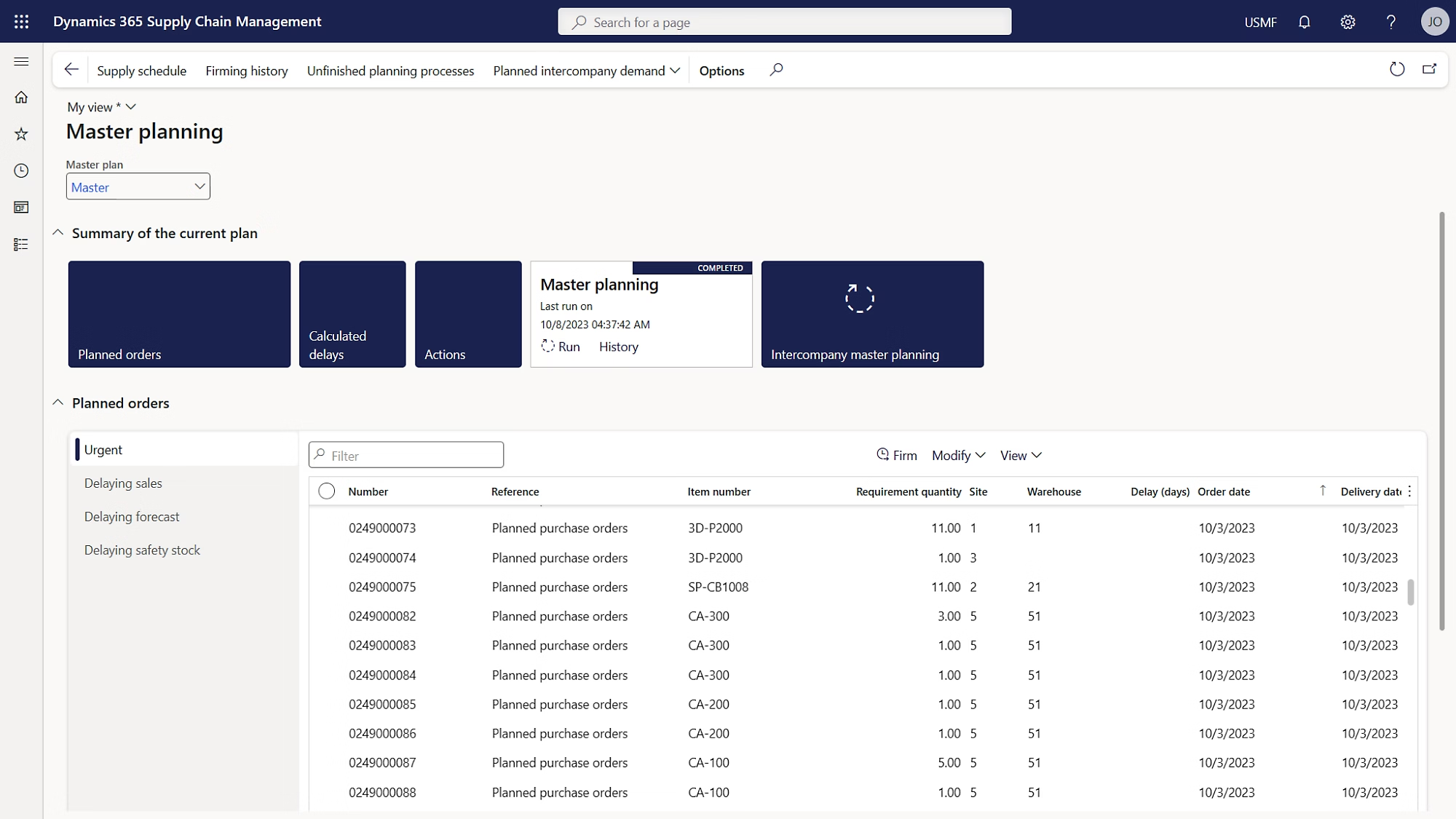
Buying decisions drive most of a distributor’s working capital. Master planning runs through the Planning Optimization service, which generates planned purchase and transfer orders from demand, supply, lead times, and planning policies. Planning Optimization replaced Microsoft’s deprecated built-in engine and performs its calculations outside the main database.
Demand planning adds forecast models, reporting, and collaboration for building a forward view of customer demand. Distributors managing high-variability items can also use Demand Driven Material Requirements Planning (DDMRP) to position inventory buffers where demand is least predictable.
Financial integration and margin visibility
This is where the Finance half of the platform earns its place. Pricing decisions, rebate accruals, freight costs, and landed costs all flow into inventory valuation, cost accounting, and financial reporting. Rebate provisions post to the ledger as they accrue rather than at settlement. Landed cost variances post against the correct inventory model, whether the item uses first in, first out (FIFO), last in, first out (LIFO), moving average, or standard cost.
The result is margin reporting that reflects what an order actually earned, after the rebate, the discount, and the freight.
AI, Copilot, and operational insights
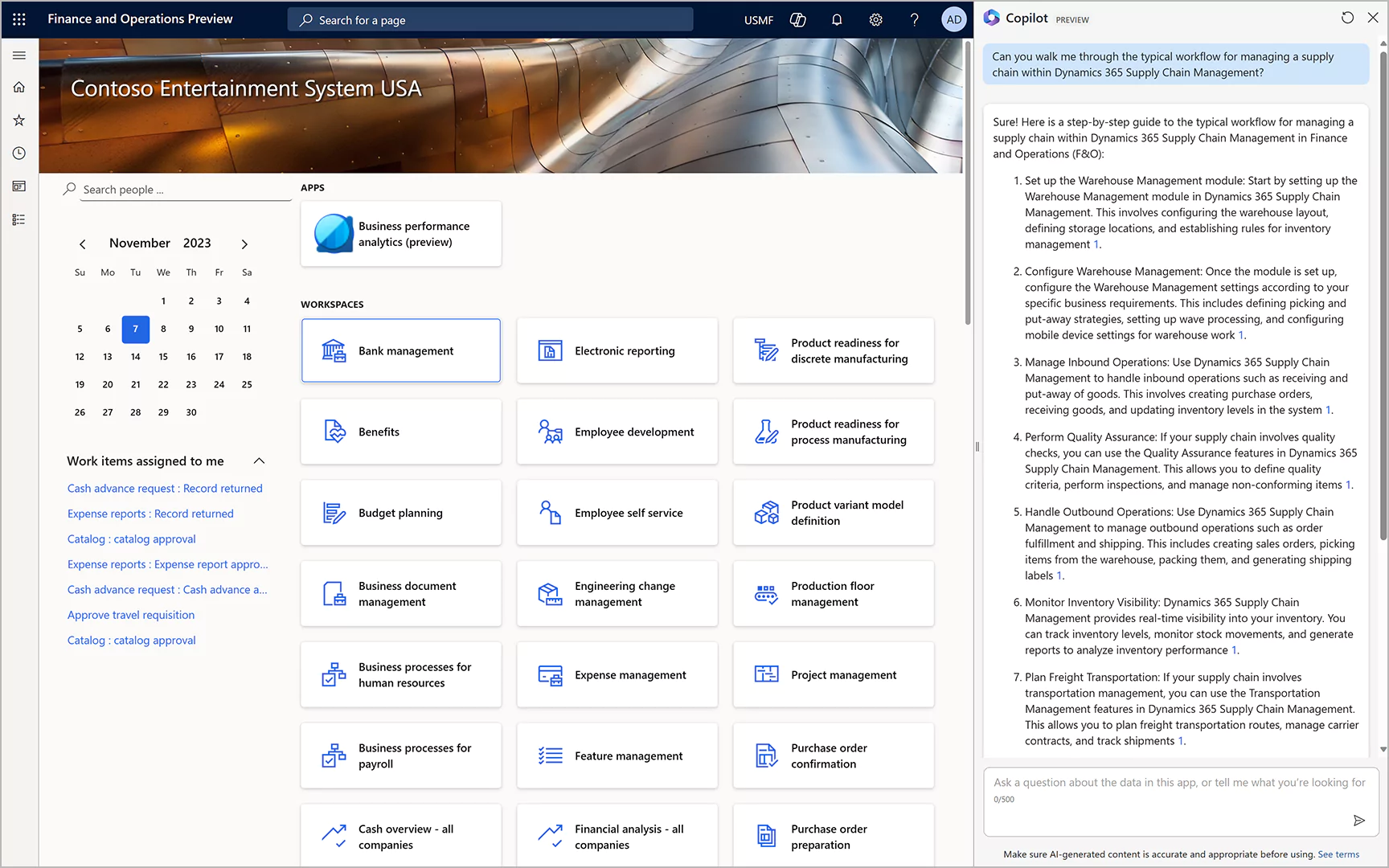
Copilot and AI agent capabilities in Dynamics 365 F&SCM help users summarize records, review operational data, and automate selected tasks. They support planners, buyers, and finance teams rather than replacing their judgment.
Capabilities relevant to distribution include:
- Record summaries on supported product, vendor, order, and warehouse pages
- Demand plan analysis for investigating forecast trends and outliers
- Purchase order change summaries that highlight supplier changes affecting downstream orders
- Warehouse workload insights that help supervisors allocate labor
- Supplier communications through the Procurement Agent, which can draft vendor follow-ups and flag proposed changes

White Paper
Understand Dynamics 365 F&SCM pricing and licensing
Licensing Dynamics 365 Finance and Supply Chain Management involves more than choosing an application. User responsibilities, required capabilities, deployment scope, and the base and attach licensing model can all affect your total cost. Use this guide to better understand your options and prepare for a more informed ERP evaluation.
Distribution models supported by Dynamics 365 F&SCM
Distributors do not all operate the same way. The table below maps common models to the capabilities that matter most for each.
Wholesale and B2B distribution
Wholesale distributors usually carry the heaviest pricing and rebate load.
Consider a distributor supplying electrical products to contractors, retailers, and national accounts. Each channel has its own price basis. Some customers hold negotiated contract pricing. Suppliers run quarterly volume rebates that only settle once the period closes.
Dynamics 365 F&SCM handles this through attribute-based pricing rules, sales agreements, and rebate agreements that accrue automatically as orders invoice. Sales teams stop maintaining side spreadsheets, and finance stops rebuilding rebate positions by hand.
Food and beverage distribution
Food and beverage distributors manage shelf life alongside price.
A produce distributor may receive lots with different expiration dates, allocate stock across several delivery routes, and settle vendor rebate programs on top of it. Batch control, shelf life management, catch weight items, and inventory status all support that work. Warehouse features such as wave processing and cluster picking help teams move perishable orders quickly.
Medical, safety, or regulated distribution
Medical, safety, and other regulated distributors need strong control over traceability, compliance, and inventory status.
A distributor of medical supplies, safety equipment, or regulated industrial products may need to track lot or serial numbers, manage expiration dates, document quality results, and quickly identify which customers received affected products if a recall or quality issue occurs. Batch and serial tracking, inventory status, quality management, and warehouse controls help support that level of visibility.
Dynamics 365 F&SCM can also help these distributors manage controlled inventory across multiple warehouses, prevent restricted or quarantined items from being shipped, and connect inventory movement with financial and operational reporting.
Import and multi-site distribution
Distributors sourcing overseas face a different challenge. The purchase order price is only part of the cost, and the arrival date is rarely firm.
Landed cost handles the first problem by estimating duty, freight, and insurance at voyage creation and apportioning them to the item level. Voyage leg tracking handles the second by updating expected delivery dates as the shipment moves. Transfer orders and transportation management then support moving that inventory between distribution centers.
When should a distributor consider Dynamics 365 F&SCM?
Dynamics 365 Finance and Supply Chain Management may fit distributors that:
- Operate several distribution centers, business units, or legal entities
- Maintain customer-specific, contract, or tiered pricing at scale
- Run active customer or vendor rebate, chargeback, or royalty programs
- Manage large SKU counts with batch, lot, or serial requirements
- Import goods and need accurate landed cost
- Capture orders across multiple channels, including B2B ecommerce
- Need reliable available-to-promise commitments at order entry
- Depend on integrations with electronic data interchange (EDI), third-party logistics, shipping, or ecommerce systems
- Operate across several currencies, countries, or tax jurisdictions
The platform can offer more capability than a smaller distributor needs. A distributor only a few warehouses, straightforward pricing, and no rebate programs may be served well by Dynamics 365 Business Central. Start the evaluation with your pricing complexity, facility count, and growth plans rather than with a feature list.
Best practices for implementing Dynamics 365 F&SCM in distribution
After guiding distributors through many Dynamics 365 F&SCM implementations, we have found these practices reduce risk:
- Map your pricing hierarchy before you configure anything. Document every price basis, discount layer, and exception. Most distributors find rules nobody has reviewed in years.
- Inventory your rebate agreements. Confirm which programs are active, how each one calculates, and who approves changes.
- Clean and validate master data. Review items, customers, vendors, units of measure, price lists, and on-hand balances before migration.
- Involve every function in design. Sales, purchasing, warehouse, customer service, and finance all touch the same order.
- Prioritize your integrations early. Define how EDI, third-party logistics, shipping, and ecommerce systems will connect.
- Test the full order-to-cash cycle. Include returns, short ships, price overrides, rebate settlement, and freight reconciliation.
- Plan for adoption after go-live. Provide role-based training, then keep refining pricing rules, planning parameters, and reporting.

Have questions about Dynamics 365 F&SCM for your distribution business?
Every distributor prices, stocks, and ships a little differently. Talk through your pricing, rebate, and inventory requirements with a consultant who works with distribution companies every day. Schedule a Dynamics 365 distribution assessment to determine whether F&SCM fits your pricing, rebate, inventory, and warehouse requirements.
Work with an experienced Dynamics 365 F&SCM distribution partner
Choosing the platform is one decision. Configuring it around how your business prices, buys, stocks, and ships is another. That second part is the work we do.
We have supported distribution and logistics organizations on Microsoft technologies for more than 20 years. As a full-service Microsoft Dynamics 365 partner, we provide:
- Evaluation and selection. We help you confirm fit and build the business case through ERP assessments and roadmap planning.
- Implementation and migration. We configure pricing structures, rebate agreements, warehouse processes, and financial posting around your operation.
- Integrations and custom development. We connect Dynamics 365 to EDI, third-party logistics, shipping, and ecommerce platforms through custom Dynamics 365 development.
- Training and change management. We deliver role-based Dynamics 365 training and change management so your teams actually use the system.
- Ongoing support and optimization. We keep refining pricing rules, planning parameters, and reporting after go-live, backed by Dynamics 365 F&O support.
Our consultants work directly with your sales, purchasing, warehouse, and finance teams. Our 90%+ client retention rate reflects stable teams, responsive service, and long-term relationships. Rand Group was also recognized as a 2026 top Microsoft Dynamics ERP partner for distribution companies.
Hear what our clients say
“Rand Group gives us the knowledge and the information to make the proper business decision to expand our business to that next level and open up new revenue opportunities.” Nigel Paskinov, Managing Director, Canadian Spa Company
“Everything we asked, Rand Group was able to accommodate. The process was extremely organized, and the implementation plan was well thought out.” – Sam Rentz, Corporate Controller, Dairy Products Inc.
Key takeaways
- Dynamics 365 F&SCM supports complex customer, contract, promotional, and attribute-based pricing at scale.
- Rebate management helps distributors calculate, accrue, settle, and audit customer and vendor rebate programs.
- Real-time inventory visibility, soft reservations, and available-to-promise calculations help teams make more reliable order commitments.
- Warehouse management, transportation, and landed cost capabilities connect physical distribution activity with inventory value and margin.
- The platform is best suited to distributors with complex pricing, multiple locations, active rebate programs, imported inventory, or multi-entity operations.
Frequently asked questions
Can Dynamics 365 F&SCM handle customer-specific and contract pricing?
Yes. The Unified pricing management module creates pricing rules from attributes tied to customers, products, and order segments. Sales agreements can also commit a customer to a quantity or value over a period in exchange for agreed pricing. Both work alongside sales trade agreements and discount agreements.
How does Dynamics 365 F&SCM manage vendor rebates and chargebacks?
The Rebate management module supports both customer and vendor rebate agreements. Vendor rebates can calculate from purchase orders or sales orders, using stepped, cumulative, rolling, or total value methods. Provisions post to the ledger as they accrue, and the deduction workbench gives finance one place to review and resolve deductions.
Can Dynamics 365 F&SCM track inventory across multiple warehouses in real time?
Yes. The Inventory Visibility add-in tracks on-hand, ordered, purchased, in-transit, returned, and quarantined quantities across warehouses, locations, and data sources. It also supports soft reservations to prevent overselling and inventory allocation to reserve stock for specific channels or customers.
Does Dynamics 365 F&SCM support available-to-promise for sales orders?
Yes. Order promising offers five delivery date control methods, including ATP and ATP plus issue margin. ATP calculates from uncommitted inventory, lead times, planned receipts, and issues. Capable-to-promise options are also available when capacity needs to be considered.
Can Dynamics 365 F&SCM handle landed cost for imported inventory?
Yes. The Landed cost module estimates duty, freight, insurance, and other import costs at voyage creation. Costs are apportioned to the item level using quantity, volume, weight, amount, or defined volumetric divisors. The module also supports goods-in-transit orders and voyage leg tracking.
Is Intelligent Distributed Order Management included with Supply Chain Management?
No. Intelligent Distributed Order Management is part of Dynamics 365 Intelligent Order Management, which is a separate application with separate licensing. Supply Chain Management provides its own fulfillment and inventory capabilities, including the Inventory Visibility service.
Is Dynamics 365 F&SCM better than Business Central for distribution?
It depends on your operation. Business Central serves many small and mid-sized distributors well, especially with straightforward pricing and a single facility. Dynamics 365 F&SCM suits companies with complex pricing structures, active rebate programs, multiple warehouses, imported goods, or multi-entity operations. For a fuller comparison, read what is the difference between D365 F&O and Business Central.
Turning pricing, rebate, and inventory complexity into an advantage
Complexity is not the problem for most distributors. Losing track of it is. When pricing rules live in spreadsheets, rebate positions get rebuilt by hand, and inventory data arrives a day late, margin quietly disappears. When those same processes run in one connected platform, complexity becomes something you can price for, plan around, and report on.
Rand Group helps distributors configure Dynamics 365 Finance & Supply Chain Management around how their business actually prices, buys, stocks, and ships. Contact Rand Group to talk through your pricing, rebate, and inventory requirements with a consultant who has done this work before.