The ROI of Sage Intacct for skilled nursing organizations

Skilled nursing organizations operate on narrow margins while managing labor costs, reimbursement complexity, regulatory requirements, and performance across multiple facilities. When financial data is spread across disconnected accounting, clinical, payroll, and spreadsheet-based systems, finance teams spend valuable time collecting information instead of using it to improve performance.
Sage Intacct can deliver a return by reducing manual accounting work, accelerating reporting, improving cost visibility, and giving the organization room to grow. The value is not limited to direct cost savings. A modern financial system can also help an existing team manage more facilities, support better decisions, and focus more time on financial strategy.
At a glance
Sage Intacct can help skilled nursing organizations lower finance costs, accelerate reporting, improve labor and purchasing visibility, and support growth without proportional hiring. Across industries, Sage reports average customer results of 250% ROI, six-month payback, a 79% reduction in close time, and a 65% productivity improvement. Actual results vary by implementation, integrations, processes, and user adoption.
Table of contents
- What is Sage Intacct for skilled nursing?
- What is the ROI of Sage Intacct for skilled nursing?
- Real-world Sage Intacct results in skilled nursing and healthcare
- What skilled nursing and healthcare clients say about Sage Intacct
- How Sage Intacct creates ROI for skilled nursing organizations
- What affects the potential ROI of Sage Intacct?
- How to maximize Sage Intacct ROI
- Partner with Rand Group to maximize Sage Intacct ROI
- Key takeaways
- Frequently asked questions
What is Sage Intacct for skilled nursing?
Sage Intacct is a cloud financial management platform that helps skilled nursing organizations manage accounting, reporting, purchasing, cash, budgeting, and multiple entities. Its dimensional reporting structure allows teams to analyze results by facility, department, payer, service line, vendor, or other operational categories without creating an overly complex chart of accounts.
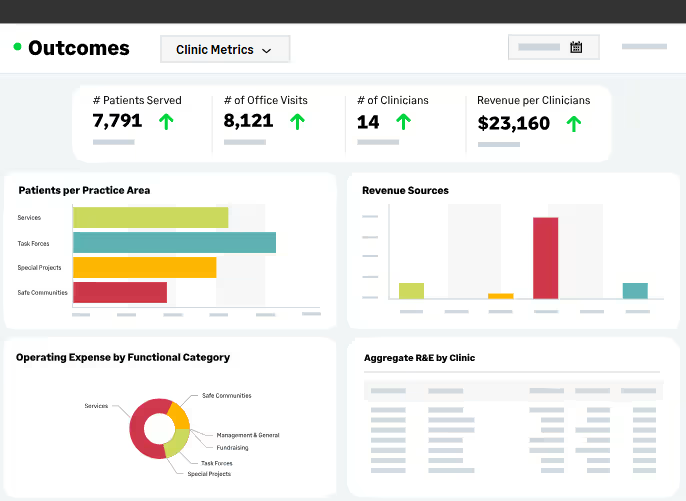
For skilled nursing organizations, Sage Intacct can connect financial data with information from clinical, census, payroll, banking, and accounts payable systems. This connected approach supports per-patient-day reporting, automated consolidations, intercompany accounting, facility dashboards, and current budget-to-actual analysis. Finance and operational leaders can work from more consistent information while reducing their reliance on spreadsheets and manual data movement.
Like any ERP platform, Sage Intacct requires an investment in software, implementation, integration, training, and ongoing support. Evaluating the expected return helps skilled nursing leaders understand whether the system can deliver enough time savings, cost control, reporting improvement, and growth capacity to justify that investment.
What is the ROI of Sage Intacct for skilled nursing?
Return on investment measures the value an organization receives compared with the total cost of purchasing, implementing, and operating a solution. For Sage Intacct, that value can extend well beyond lowering software costs.
Automation and AI capabilities can reduce the time spent entering invoices, managing the close, checking data, and preparing reports. Sage Intacct also provides real-time reporting and multi-entity tools that help finance teams support more locations without increasing administrative effort at the same rate. Newer Sage AI capabilities extend this value by supporting accounts payable automation, close management, anomaly detection, financial analysis, and connected AI workflows.
For a skilled nursing organization, ROI may include:
- Hard-dollar savings: Reduced staffing, audit, software, processing, or administrative costs
- Labor capacity: Hours finance employees can redirect to analysis, planning, and facility support
- Growth capacity: More facilities or entities managed without proportional staff growth
- Cost control: Better visibility into labor, overtime, purchasing, and departmental spending
- Faster decisions: Current facility and patient-day reporting instead of delayed spreadsheet analysis
Sage Intacct customer ROI benchmarks
Across industries, Sage reports that Sage Intacct customers achieve an average 250% return on investment, a six-month payback period, a 79% reduction in close time, and a 65% improvement in productivity.
0 %
Average return on investment
0
Months average payback period
0 %
Productivity improvement
For skilled nursing organizations, these returns may appear as fewer hours spent consolidating facility results, less manual payroll and invoice entry, faster income statement reporting, and more time for cost and patient-day analysis. The value may be especially significant for multi-facility organizations that currently rely on separate accounting databases or spreadsheet-based consolidation.
Forrester Total Economic Impact study
In a Sage-commissioned Total Economic Impact study, Forrester interviewed four Sage Intacct customers and created a composite organization to model the platform’s potential financial impact. Over three years, the composite organization generated $2.1 million in present-value benefits against approximately $387,000 in present-value costs, producing a net present value of $1.7 million and a 441% return on investment.
0 %
Three-year ROI
$ 0
Million present value of benefits
$ 0
Million net present value
The results of this composite organization study can be used as a financial framework for evaluating the potential value of Sage Intacct. Several of the modeled benefits are highly relevant to skilled nursing organizations, including delayed hiring, greater accounting productivity, faster reporting, lower audit costs, and improved multi-entity visibility.
Together, the Sage benchmarks and Forrester study provide useful reference points for understanding potential Sage Intacct ROI. The next section looks at how these returns have appeared in real skilled nursing and healthcare organizations.
Real-world Sage Intacct results in skilled nursing and healthcare
The Sage and Forrester benchmarks establish the potential financial impact of Sage Intacct. Customer outcomes show how that return can take shape in skilled nursing and healthcare organizations through lower costs, greater finance capacity, scalable growth, and stronger financial control.
The examples below prioritize skilled nursing outcomes and include relevant healthcare results where organizations face similar multi-entity accounting, reporting, and finance capacity challenges.
Faster payback and lower costs
Skilled nursing organizations must closely manage labor, overtime, purchasing, and administrative expenses. Sage Intacct can support faster payback by reducing finance workload, avoiding additional hiring, and giving department leaders more control over spending.
0
Month payback period
$ 0
In annual savings
0 %
Lower spending
Bay County Medical Care Facility is a government-owned skilled nursing facility that integrated Sage Intacct with its MatrixCare clinical system. Automated purchasing workflows and department-level dashboards helped managers understand their available budgets and spending throughout the month. The organization reported a 5% to 7% reduction in spending, a 35% reduction in overtime, and an overall 3% to 4% reduction in labor costs.
Personal Healthcare also used Sage Intacct to maintain a lean finance operation. The organization brought more accounting work in-house while avoiding approximately 1.5 additional hires, creating an estimated $80,000 in yearly savings. It also reduced its monthly close from one week to one or two days and consolidated financials across eight entities.
Greater finance productivity
Skilled nursing finance teams often collect information from multiple facilities, payroll systems, clinical applications, and spreadsheets. Sage Intacct can reduce this manual work by centralizing data, automating recurring processes, and making facility-level reporting easier to produce.
0 %
Reduction in accounting input time
0 %
Faster income statement reporting
0 +
Hours saved in monthly reporting
Plantation Management Company, a Rand Group client, consolidated approximately 30 facility, property, and ancillary entities from American HealthTech and QuickBooks into one Sage Intacct environment. The organization reduced accounting input time by at least 50% and generated income statements approximately 50% faster while including per-patient-day reporting.
Bay County achieved similar gains by replacing Excel-based work and duplicate entry with automated purchasing, payroll uploads, and a connection to MatrixCare. These changes improved overall finance productivity by at least 50% and reduced a three-week close to one or two days.
Praxi OP, another Rand Group client, reported significant reductions in recurring reporting work. Saving more than 40 hours each month gives a finance team the equivalent of an additional workweek for analysis, planning, audit preparation, and operational support.
Growth without proportional finance headcount
Growth can add significant complexity for skilled nursing organizations as they acquire facilities, establish new entities, and increase transaction volume. Sage Intacct helps finance teams scale by standardizing processes and automating multi-entity consolidation, reporting, and intercompany activity.
0
Entities unified in one system
0 +
Locations added without staff increase
0 %
More entities managed without additional staff
Plantation Management Company gained one environment for processing and reporting across approximately 30 entities. Instead of entering transactions and consolidating results through separate systems, the finance team can manage operating companies, property companies, and related businesses from Sage Intacct.
Spine Team Texas used Sage Intacct to support growth across its multi-entity healthcare organization. Since implementing the system, the organization has added at least four clinics and one ambulatory surgery center without increasing finance staff.
West Harbor Healthcare operates five nursing homes and a separate therapy business. The organization estimated that its three-person finance team would have needed to double if it had remained on QuickBooks and Excel. Sage Intacct also eliminated up to 40 hours of manual accounts payable and payroll work each week.
A senior living organization increased the number of entities managed by 50% without adding accounting staff. Automated consolidation, intercompany processing, accounts payable workflows, and reporting helped the existing team support a larger and more complex operation.
Better financial visibility and process control
Skilled nursing organizations need consistent financial information across facilities, departments, property companies, and related entities. Sage Intacct provides dimensional reporting, dashboards, workflows, and transaction-level detail that help finance teams maintain control while giving operational leaders clearer insight into performance.
0 %
Increase in intercompany transaction efficiency
0 %
Fewer revenue journal entries
0 %
Reduction in reconciliation time
A senior living organization used Sage Intacct to automate intercompany processing across a complex multi-entity structure. The organization increased intercompany transaction efficiency by 97% by reducing the process from 32 steps to one.
Spine Team Texas reduced revenue journal entries by 83% after moving to Sage Intacct. Fewer manual entries helped simplify recurring accounting work while improving consistency and control.
Praxi OP reduced reconciliation time by 85% through more efficient financial processes and access to current data. The improvement gave the finance team more time for review, reporting, and other higher-value work.

Maximize the ROI of Sage Intacct
The right system design can turn Sage Intacct automation, reporting, and multi-entity capabilities into measurable business value. Rand Group can help you evaluate your current processes and build a Sage Intacct roadmap around the returns that matter most to your organization.
What skilled nursing and healthcare clients say about Sage Intacct
The metrics above show how Sage Intacct can create measurable value through lower costs, faster reporting, stronger financial control, and scalable growth. Client feedback adds context by showing how those improvements affect daily work across finance and operations.
Skilled nursing organizations often value Sage Intacct for its multi-entity accounting, per-patient-day reporting, facility-level dashboards, and flexible financial analysis. These capabilities help finance teams connect data across facilities, give administrators clearer performance insights, and reduce reliance on manual reports.
For a broader evaluation of the platform’s features, benefits, limitations, and industry fit, read our Sage Intacct review.
The following feedback comes from real Rand Group clients that use Sage Intacct.
“Sage Intacct has been a blessing for our team. For skilled nursing, per patient per day reporting is a big part of how we review performance, and being able to build that into our income statements and analysis reports was a major factor for us. It has the reporting capabilities we need today, and as we continue working in the system, we can see even more opportunities for growth.”
– Taylor Peak, Accounting Manager, Plantation Management Company
“Without Sage Intacct, we’d be operating nearly blind. Now, data is converted swiftly into actionable information that our administrators can easily interpret and utilize for rapid decision-making.”
– Jeff Cantrell, CFO, Central Management
“Since we implemented Sage Intacct, we have added at least four clinics and one surgery center without increasing my staff. The system has allowed us to keep up with growth while continuing to work efficiently.”
– Lisa Morris, Accounting Director, Spine Team Texas
How Sage Intacct creates ROI for skilled nursing organizations
Sage Intacct creates ROI for skilled nursing organizations by reducing manual finance work, improving facility-level visibility, and helping existing teams support more entities and locations. The strongest returns often come from using automation, multi-entity accounting, integrations, reporting, and AI together as part of one connected financial system.
- Automates routine finance work: Reduce manual invoice entry, journal entries, reconciliations, approvals, and month-end close tasks across skilled nursing facilities.
- Consolidates complex entity structures: Manage operating facilities, property companies, management entities, and ancillary businesses in one financial environment.
- Connects financial and operational data: Integrate clinical, census, payroll, banking, and accounts payable systems to reduce duplicate entry and improve data accuracy.
- Supports per-patient-day reporting: Analyze revenue, labor, costs, and profitability using measures that reflect skilled nursing performance.
- Improves facility accountability: Give administrators current dashboards, budget-to-actual results, and transaction details for their facilities.
- Uses AI to expand finance capacity: Apply AI-powered automation to invoices, close activities, financial analysis, data access, and exception review.
- Supports multi-facility growth: Add skilled nursing facilities, entities, and transaction volume without increasing manual processing at the same rate.
What affects the potential ROI of Sage Intacct?
The potential ROI of Sage Intacct depends on both the total investment and the value the system creates over time. Skilled nursing organizations should consider software, implementation, integrations, training, support, and internal project effort when evaluating the full cost.
The expected benefits should reflect the organization’s current processes and growth plans. Common sources of value include finance hours saved, faster reporting and close cycles, avoided hiring, lower audit or software costs, improved labor and purchasing control, and the ability to support more facilities.
Factors that affect Sage Intacct ROI include:
- Current manual workload: Organizations that rely heavily on spreadsheets, duplicate entry, and manual consolidation may have more opportunities to save time.
- Number of facilities and entities: Multi-facility organizations can gain more value from automated consolidation, intercompany accounting, and standardized reporting.
- Integration requirements: Connections with clinical, census, payroll, banking, and accounts payable systems can reduce data entry and improve reporting accuracy.
- Implementation scope: Modules, workflows, reports, integrations, and custom requirements affect both the investment and the potential return.
- Data readiness: Accurate and organized data can reduce implementation effort and improve reporting after go-live.
- Staffing and growth plans: Expected acquisitions, new facilities, and future hiring needs affect the value of a scalable financial system.
- User adoption: Finance teams and facility leaders must consistently use the new workflows, dashboards, and reports to achieve the expected benefits.
- Ongoing optimization: Continued training, automation, and process improvement can increase the return after implementation.
Organizations should use their own staffing costs, transaction volumes, processing times, and growth projections when estimating potential ROI. This creates a more realistic business case than relying only on broad industry benchmarks.
How to maximize Sage Intacct ROI
Skilled nursing organizations can maximize Sage Intacct ROI by focusing first on the processes that create the most manual work, delay, or risk. High-value priorities often include multi-entity consolidation, accounts payable, payroll integration, patient-day reporting, intercompany accounting, and facility-level dashboards.
A phased roadmap can help the organization capture value without adding unnecessary complexity. Start with the capabilities that support the strongest business case, measure the results, and expand automation and reporting as users become more comfortable with the system.
Ways to maximize Sage Intacct ROI include:
- Set measurable goals: Define expected improvements in close time, reporting, staffing capacity, or processing effort before implementation.
- Prioritize high-value processes: Focus on workflows that consume the most time or create the greatest reporting delays.
- Connect key systems: Integrate clinical, census, payroll, banking, and accounts payable data where it reduces duplicate work.
- Design reports around skilled nursing decisions: Build facility, department, labor, budget, and per-patient-day reporting around how leaders manage performance.
- Train users by role: Give finance employees, administrators, and executives the specific tools and reports they need.
- Track results after go-live: Measure time savings, close performance, reporting speed, and staffing capacity against the original business case.
- Continue improving the system: Add automation, AI capabilities, dashboards, and workflows as new opportunities emerge.
- Work with an experienced partner: Use industry and product expertise to align the implementation, integrations, reporting, training, and optimization roadmap with your skilled nursing organization’s ROI goals.
Partner with Rand Group to maximize Sage Intacct ROI
Sage Intacct delivers the greatest return when it is configured around the organization’s financial structure, operational systems, reporting requirements, and growth plans. An experienced implementation partner can help define measurable goals, prioritize high-value automation, design meaningful dashboards, and avoid unnecessary complexity.
Rand Group is a Sage Diamond Tier partner with specialized experience serving skilled nursing and healthcare organizations. Our team brings more than 35 years of Sage experience and supports software selection, implementation, integration, reporting, training, and ongoing optimization. Rand Group has completed more than 3,000 engagements for more than 1,200 clients across North America and maintains a 90% client retention rate.
Rand Group can help skilled nursing organizations maximize Sage Intacct ROI through:
- Implementation: Configure Sage Intacct around your entities, facilities, workflows, reporting needs, and financial controls.
- Customization: Tailor dashboards, reports, approvals, and processes to support how your organization operates.
- Integration: Connect Sage Intacct with clinical, census, payroll, banking, accounts payable, and other business systems.
- Reporting and analytics: Build facility-level, departmental, budget-to-actual, and per-patient-day reporting for finance and operational leaders.
- Automation: Reduce manual work across accounts payable, reconciliations, intercompany accounting, close tasks, and recurring processes.
- AI enablement: Identify practical uses for Sage Intacct AI, Sage Copilot, and connected AI workflows while maintaining appropriate controls.
- Training and user adoption: Help finance teams, administrators, and executives use the system effectively in their roles.
- Ongoing support and optimization: Improve the system over time as your organization adds facilities, entities, users, and new reporting requirements.
Key takeaways
- Sage reports that Sage Intacct customers achieve an average 250% ROI and a six-month payback period across industries.
- A Sage-commissioned Forrester composite study calculated a 441% return on investment over three years.
- Skilled nursing organizations can generate ROI through lower costs, faster reporting, improved finance productivity, and avoided hiring.
- Sage Intacct supports multi-facility growth through automated consolidation, intercompany accounting, integrations, and standardized reporting.
- Real-world skilled nursing results include a five-month payback, 50% faster income statement reporting, and growth without proportional finance headcount.
- Sage Intacct ROI depends on implementation design, data readiness, user adoption, integrations, and ongoing optimization.
Frequently asked questions
What is the ROI of Sage Intacct for skilled nursing organizations?
Sage reports that Sage Intacct customers achieve an average 250% ROI and a six-month payback period across industries. Skilled nursing organizations have also reported outcomes such as a five-month payback, 50% less accounting input time, 50% faster income statement reporting, and approximately 90% faster close cycles.
How quickly can Sage Intacct pay for itself?
Sage reports an average payback period of six months across industries. One skilled nursing organization reported that Sage Intacct paid for itself in approximately five months.
How does Sage Intacct reduce costs for skilled nursing facilities?
Sage Intacct can lower costs through finance automation, avoided hiring, stronger purchasing control, and better labor visibility. Reported skilled nursing and healthcare outcomes include $80,000 in annual staffing savings, 5% to 7% lower spending, and a 35% reduction in overtime.
Can Sage Intacct help a skilled nursing organization grow without adding finance staff?
Yes. Sage Intacct can automate multi-entity consolidation, reporting, and intercompany accounting so existing teams can support more facilities. Across skilled nursing and healthcare organizations, reported outcomes include five or more locations added without increasing finance staff, three potential hires avoided, and 50% more entities managed without additional accounting staff.
How does Sage Intacct improve financial reporting for skilled nursing organizations?
Sage Intacct supports reporting by facility, department, payer, service line, vendor, and other dimensions. It can also combine financial, clinical, census, and payroll data to support per-patient-day reporting, budget analysis, and facility dashboards.
What Sage Intacct features create the most ROI for skilled nursing organizations?
The largest sources of ROI often include multi-entity accounting, automated consolidation, accounts payable automation, intercompany processing, operational integrations, per-patient-day reporting, and facility-level dashboards.
How can Sage Intacct AI improve ROI?
Sage Intacct AI can reduce manual work across invoice processing, close management, anomaly detection, exception review, and financial analysis. These capabilities give finance teams more time for planning, review, and facility support.
What costs should skilled nursing organizations consider when evaluating Sage Intacct ROI?
Organizations should consider software licenses, implementation, data migration, integrations, training, internal project time, ongoing support, and future optimization. These costs should be compared with expected time savings, avoided hiring, lower administrative expenses, and increased facility capacity.
What factors affect the ROI of a Sage Intacct implementation?
Sage Intacct ROI depends on the current manual workload, number of facilities and entities, integration requirements, data readiness, implementation scope, user adoption, and ongoing optimization. Organizations with fragmented systems and spreadsheet-heavy processes may have more opportunities to create measurable value.
How can skilled nursing organizations maximize Sage Intacct ROI?
Organizations can maximize ROI by setting measurable goals, prioritizing high-value processes, connecting key systems, designing skilled nursing reports, training users by role, and measuring results after go-live. A phased roadmap can help capture value while limiting unnecessary complexity.
Why should a skilled nursing organization work with a Sage Intacct partner?
An experienced Sage Intacct partner can align the system with the organization’s entity structure, integrations, reporting needs, automation goals, and growth plans. Partner support can also improve implementation quality, user adoption, and long-term ROI.
Turn Sage Intacct into measurable value
Sage Intacct can help skilled nursing organizations reduce manual finance work, improve facility-level reporting, control costs, and support growth across multiple entities. The strongest return comes from aligning the platform with the organization’s processes, integrations, reporting requirements, and long-term goals.
A clear implementation and optimization roadmap can help your organization focus on the improvements with the greatest financial and operational impact. Contact us today to evaluate your current processes, define your ROI goals, and build a Sage Intacct roadmap for your skilled nursing organization.